
AI Jobs in Fintech Are Taking Off in Wales: Here’s Why
05 May, 2026
AI Jobs in Fintech Are Taking Off in Wales: Here’s Why
Wales’ fintech sector is entering a new phase of maturity and momentum, with growth in employment, investment, and global expansion driving its evolution into a key engine of economic value and job creation. At the heart of this progress is the increasing adoption of artificial intelligence. Across the FinTech Wales network, companies are embedding AI into core operations, enhancing how they deliver products, improve efficiency, and scale innovation, with many now establishing dedicated AI capabilities to support this shift.
A Sector on the Rise: The Welsh FinTech and AI Growth Story
The rapid growth of the AI sector is reshaping financial services. Across the UK, AI companies have increased by 85% in just two years, with AI roles rising by 33% year-on-year. In Wales, this momentum is translating directly into fintech, where companies are embedding AI into products, operations, and decision-making at scale. This shift is accelerating, with skills in AI-exposed roles evolving 66% faster than in other jobs, more than 2.5 times faster than just a year ago.
As AI capabilities expand, their impact is being felt across virtually every industry—and fintech is no exception. The sector is rapidly converging with AI, big data, and ESG, accelerating both innovation and transformation.
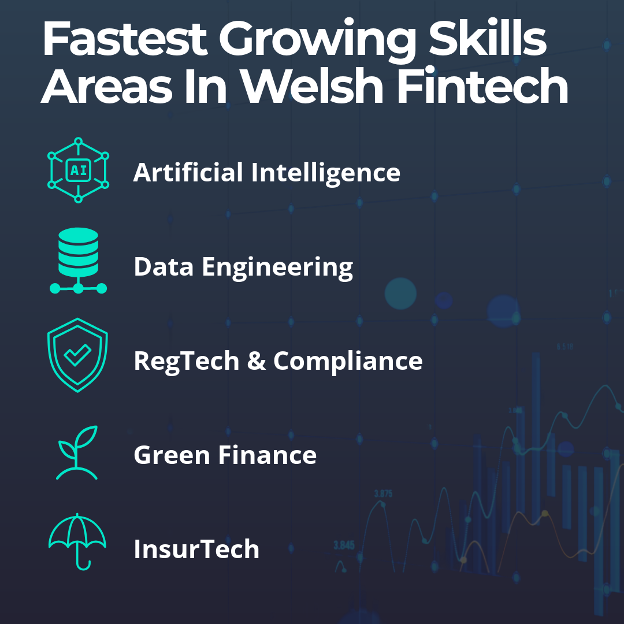
Insights from the FinTech Wales ecosystem highlight growing demand for skills across AI, data, cybersecurity, and compliance, as fintech companies increasingly adopt advanced technologies. As these capabilities develop, more specialised and interconnected areas such as green finance, regtech, and proptech are emerging. reflecting a shift toward a more diverse, mature, and skills-driven ecosystem.
This is opening the door to a new generation of fintech products, ones that can process vast amounts of data in real time, strengthen risk management, and deliver more intuitive, personalised customer experiences at every touchpoint.
Across the FinTech Wales ecosystem, this shift is already taking shape. Starling Bank has recently launched an agentic AI financial assistant that actively helps customers manage their money, while firms such as Planna are using AI and rich data to generate property insights for homeowners and lenders. Bipsync is also applying AI to transform how institutional investors manage research and workflows, demonstrating how these capabilities are being embedded across different parts of the financial services value chain.
This is also the stage where companies like Creditsafe are investing heavily in AI-driven innovation, embedding these technologies across their operations to drive efficiency, insight, and real business value.
Creditsafe’s Counter-Intuitive Take On AI
In recent years, fintech companies have moved from exploring AI to embedding it at the core of how they operate. Creditsafe is a clear example of this shift. The global business intelligence company has established a dedicated R&D function focused on advancing AI capabilities across the business.
The team is applying AI across a wide range of use cases, from document processing and data analytics to enhancing sales intelligence and internal decision-making. Alongside the pace of progress, what stands out is the team’s diverse mix of backgrounds and its fresh approach to hiring: prioritising problem-solving ability and real-world application over traditional pathways.
Alex Erol is one of the problem-solvers that joined the team, he says:
“What I enjoy most about being part of the AI team is the opportunity to work on projects with real potential to make an impact. We combine analytical problem-solving with the latest AI, machine learning, and GenAI approaches to turn complex data into practical business outcomes for Creditsafe. Seeing how our technical work translates into real value is hugely motivating. I also found the hiring process refreshingly fair and relevant.”
With team members from across the UK and around the world, backgrounds vary widely; some have been to university, others have not; some have experience in fintech, while others are new to the sector. What they all have in common is their ability to flex their thinking to find creative solutions to challenges.
Each member of the team was given a complex problem to solve during the selection process using AI, with this task taking more importance than qualifications and experience. Dominic Parkes directly manages the team and oversaw the process:
“From day one the goal wasn’t to build a team of people who simply know AI – it was to build a team of problem-solvers. We deliberately looked for people who think differently and can apply AI to real business challenges. That diversity of thinking is what makes the team so effective.”
Creditsafe’s approach to AI is centred on empowering people, providing tools that enhance their work, saving time from tasks that can be automated, while improving systematic improvements to products and tools.
What Might Future Jobs in Finance Look Like With AI?
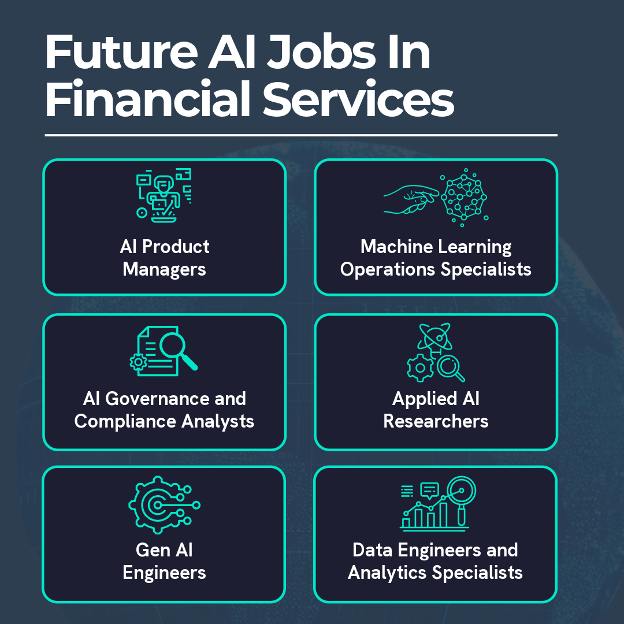
AI is reshaping how financial services operate, changing not only how companies work but also how they deliver value to customers. As AI becomes embedded across business processes, new roles are beginning to emerge, reflecting a shift toward closer collaboration between people and technology.
While AI enables faster, more accurate handling of large volumes of data, its real impact lies in how it enhances human work. By automating repetitive tasks and improving efficiency, it allows professionals to focus on higher-value activities such as strategy, innovation, and customer experience.
The key shift will be in how effectively organisations and individuals can work alongside AI. This requires strong foundations in data quality, clear governance, and the ability to apply oversight and judgement to AI-driven outputs.
As a result, demand is not limited to AI developers alone. There is growing need for a broader range of skills, including data science, risk and compliance, and roles that combine technical expertise with deep industry knowledge, reflecting the rise of more hybrid, future-focused careers across fintech.
Feeling enthusiastic about the opportunities AI can offer to people and businesses, Dominic adds:
“Our approach to AI has always been practical. We’re not trying to replace people – we’re trying to give them better tools. When AI removes repetitive work, it frees our teams to focus on judgement, creativity and building stronger relationships with customers.”
Career Pathways: What Experts Want New Talent to Know
For those considering a move into AI-related roles, the pace of change can feel daunting. However, a consistent message across the sector is that becoming an AI specialist isn’t a prerequisite for building a future-ready skillset. Developing capabilities in areas such as data, digital literacy, and problem-solving can be just as valuable in an AI-driven environment.
Dominic reflects: “The most exciting part of this growth is the talent coming into the ecosystem. As more people build skills in data, AI and engineering, Wales is becoming a place where ambitious ideas can turn into real products very quickly.”
Where Next For Wales, A Growing Forefront for Fintech?
Momentum continues to build across Wales, with increasing focus on creating high-value jobs and supporting long-term sector growth. Supported by Welsh Government initiatives such as the alongside strong academic collaboration and industry-led programmes, the foundations are in place for Wales to scale its impact on both a UK and global stage.
AI Hub, a partnership between FinTech Wales and AI Wales partnership has been launched to help to accelerate AI adoption across the ecosystem and connect businesses with the expertise needed to innovate and grow.
As both AI and fintech continue to expand, the intersection between them is becoming one of Wales’ defining strengths—positioning the nation as a competitive, forward-looking hub for financial innovation.
“This is an exciting time for Wales. With a growing talent base, strong collaboration across the ecosystem, and businesses increasingly embedding AI to enhance how their teams work, the foundations are firmly in place for continued growth. Companies like Creditsafe demonstrate how AI can be applied in practice—empowering people, improving decision-making, and driving real business value. As this momentum continues, Wales is well positioned to strengthen its reputation as a globally competitive fintech hub, where innovation and talent come together to shape the future of financial services.’ Sarah Jones, CEO, FinTech Wales
Discover careers at Creditsafe: https://careers.creditsafe.com/gb
This article was developed in collaboration between FinTech Wales and Creditsafe.